For waiting rooms

A waiting room TV that runs itself, on the screen already on the wall.

Hours, services, who is in today and the notices your receptionist repeats, on a schedule, in the television's own browser. No player box, no install, and the first screen is free forever.

No card · no box to buy · pairs in about two minutes

The short answer

A waiting room TV is a scheduled slideshow, not a queue board. ChannelOS runs one from a web page in the television's own browser, so a smart TV, a cheap HDMI stick or a laptop in kiosk mode is the whole hardware bill. You put up the things a practice repeats all day (opening hours, the services list, who is in today by role, health information you already hand out on paper, and seasonal notices such as a flu clinic or a holiday closure), then schedule them across the day and leave it alone. What it cannot do is show a live token number or a called patient, because it reads no external system at all. If that is the job, buy a queue display that talks to your practice software instead.

Content

What should go on a waiting room TV?

The questions the front desk answers all day, and nothing about an individual patient. That single test settles almost every argument about what belongs on the screen: if it is already said out loud at reception or handed over on a leaflet, it can go up. If it names a person waiting in the room, it cannot.

You do not have to draw any of it from scratch. The healthcare and clinic templates are waiting room boards you can remix and edit down to your own hours and services, and the rest of the templates gallery is there when the practice also runs a pharmacy counter or a reception desk that sells something. Describe the board in a sentence and AI drafts the slides, then every heading, line and price is a selectable element you can change yourself.

Who should not buy this

Should a clinic that wants a token or queue board buy this?

No. If the job is a live token number, a called patient, a counter position or a wait time pulled out of your practice management system, ChannelOS cannot do it. We have no integration seam of any kind: no hospital management system connector, no POS connector, no calendar feed, not even a calendar file parser. Nothing in our API reads an external system. A doctor list on our screen is a slide somebody typed, and it is stale the first time a locum swaps in.

You want a live queue number read out of your practice software, and we cannot read from any system at all. We are a scheduled slideshow, so the number on our screen would be whatever someone last typed. Buy a queue display that talks to your PMS or POS.

There is a second refusal that has nothing to do with what we have built yet. Putting patient names or appointment times on a wall in a public room is a live privacy exposure under India's DPDP Act 2023, Brazil's LGPD and the HIPAA Privacy Rule in the United States. We give you no redaction control, no audit log and no way to prove afterwards what was displayed. We are not going to be the vendor that lets a practice find that out. The same goes for treatment claims, procedure price promises and before and after photographs, which are a problem under Indian medical advertising rules and land on your registration rather than ours.

If this is what you want, buy that instead

What you want What to buy
A live token number, called from the desk or read out of your practice software A queue display that talks to your PMS or POS. Buy the queue system first, and buy its screen with it.
Patient names, appointment times or case detail on the wall Nothing from us. That is a privacy exposure under the DPDP Act, the LGPD and HIPAA, and we give you no redaction control and no audit log.
A screen that keeps playing through a power cut with no connection A signage player with local storage, from a company that sells the hardware. Ask them what the cache actually holds.
Treatment claims, procedure price promises or before and after photographs Nothing from us. Indian medical advertising rules land that problem on your registration, not on ours, and we will not help publish one.
A rotating slideshow of hours, services, rotas and notices, on the TV already there ChannelOS. First screen free forever, no box, and you edit it from your phone.

We would rather lose the sale here than after you have mounted a screen. Everything below is the job we can actually do, which is the slideshow half of the room.

Hardware

Do I need a media player box for a waiting room TV?

No. ChannelOS is a web page, so anything in the building that can open one can be the screen: an Android TV, a Google TV, a webOS or Fire TV set, a cheap HDMI stick if the television is old, or a spare laptop in kiosk mode on the HDMI port. There is nothing to sideload, no per device licence and no appliance in the quote.

Pair · about two minutes

Open it on the TV, pair it from your phone.

The whole setup is one page opened on the set and one scan from the phone in your pocket. The longer version, including what to do with a television that has an awkward browser, is in how to turn your TV into digital signage, and the case for skipping the box entirely is in signage without an Android player.
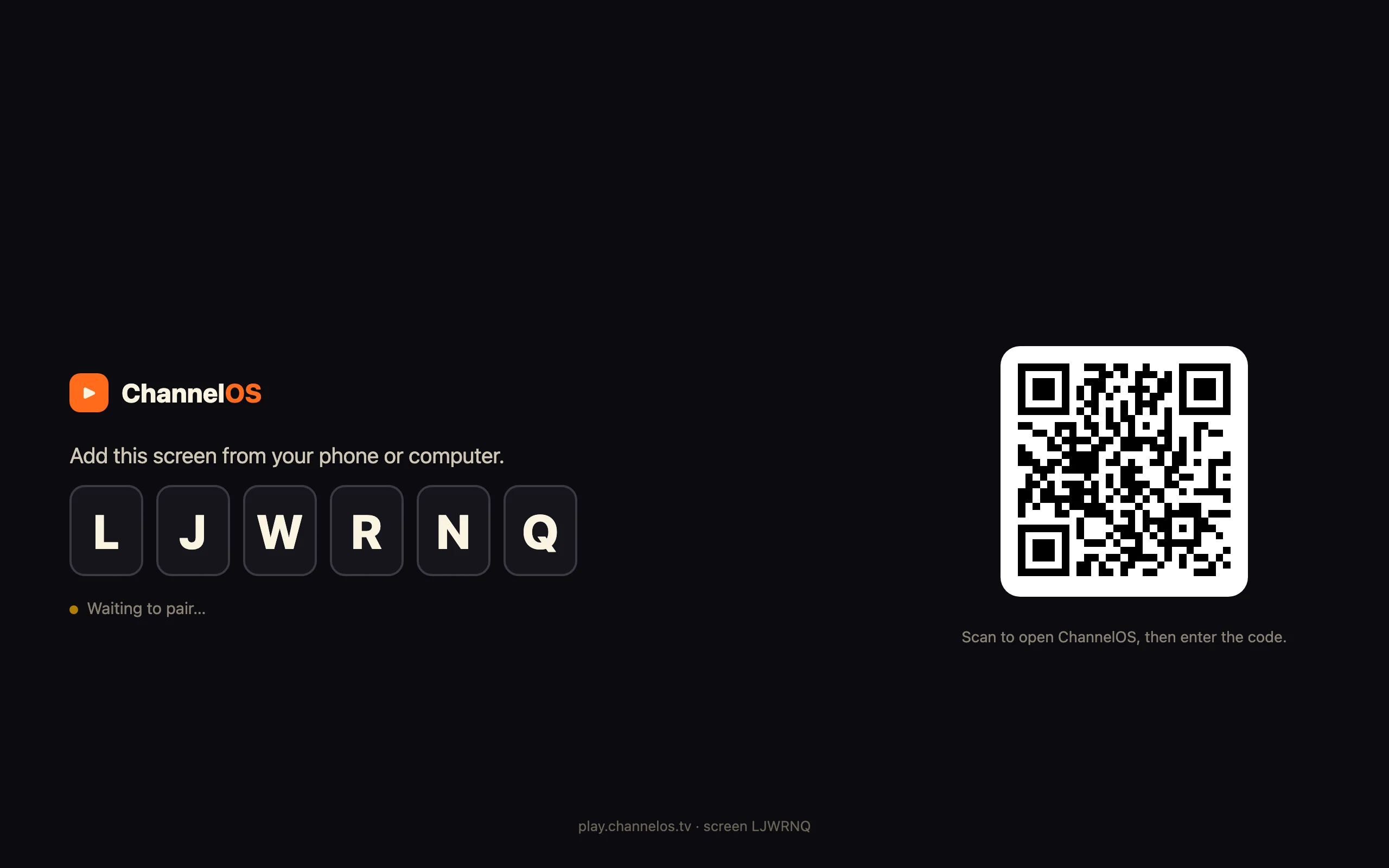
  • On the television, open play.channelos.tv in its browser. It shows a six character code and a QR
  • Scan the code with your phone and the screen is paired to your workspace
  • Point that screen at a channel and it plays whatever the schedule says is on right now
  • Change a slide later and the screen picks it up in seconds, with nobody standing in the room
play.channelos.tv
A television showing the ChannelOS pairing screen with a six character code and a QR code

When a box is the right answer

A screen that is already playing keeps playing if the wifi drops, but it needs the connection back to come up again after a power cut, because nothing is cached on the television itself. If a screen has to survive a long outage entirely on its own, buy a player from a company that sells one and ask them about local storage. That is a real reason to pay for hardware. Ours is not one of them.

The first screen is free forever, which covers the reception television itself. A second room, a second site or a pharmacy counter is billed per screen per month, and the current rates are on the pricing page. Scheduling is the paid line. Building the boards is free, and having the screen swap them at nine o'clock on its own starts on the Solo plan, with channels, live takeover and one-tap background removal.

The day

How do you schedule a waiting room TV across the day?

You place each board on the hours it should air, on a channel, and the screen follows its own clock from then on. A channel is a named feed with a real daily timeline, so the morning board comes down by itself, the closing notice goes up by itself, and the screen is dark outside opening hours without anybody walking over to it. Scheduling by hour and weekday is a paid feature, from the Solo plan up.

One weekday on a waiting room channel A timeline from 7am to 8pm. A doors open board runs from 7 to 9, the main waiting room rotation from 9 to 5, a closing notice from 5 to 7, and the screen is off from 7pm. A dated flu clinic notice sits over the plan from 9am to 1pm for the month of November. DATED OVERRIDE Flu clinic notice · 1 to 30 Nov WEEKLY PLAN Doors open Waiting room rotation · hours, services, rota, notices Closing Off 07:00 09:00 13:00 17:00 19:00 20:00
One weekday on a channel. The orange block is the board that runs most of the day. The dashed bar above it is a dated show placed over the weekly plan for November only, so the flu clinic notice appears and disappears on its own dates and the underlying plan is never edited. Weekends can run a different plan entirely, and the screen has nothing scheduled after 7pm, which is how quiet hours are expressed here.
  1. STEP 1

    Build the boards

    One for the hours and services, one for the rota, one for the current notice. Remix a healthcare template or describe it in a sentence and edit what comes back.

  2. STEP 2

    Place them on a channel

    Drop each board on the hours it should air, and give the seasonal one a start and an end date so it lifts itself off the plan when it is done.

  3. STEP 3

    Tune the screen to it

    Pair the TV once and point it at that channel. A second room or a second branch tunes into the same channel and stays in step with no extra work.

Waiting room TV questions.

What is waiting room TV software?
Waiting room TV software puts a rotating set of slides on the screen in a reception or waiting area and changes them on a schedule. In ChannelOS the slides carry the things the front desk repeats all day: opening hours, session times, the services you offer, which practitioners are in, what to bring, where to go, and the seasonal notices. It runs as a web page in the television's own browser, so there is no player box and nothing to install, and you edit a slide from your phone rather than reprinting a sheet of A4.
Can a waiting room TV show which practitioners are in today?
Yes, as a slide someone types and edits, by role and service rather than by patient. A rota slide reading Dr Menon, general medicine, 9 to 1 is a normal thing to display, and it is edited in seconds when a locum swaps in. What it is not is live: nothing reads your rota software, so if the list changes twice a day and nobody updates the slide, the screen will be wrong. Treat it as a printed notice that is quicker to change, not as a feed.
Is it safe to put patient names or appointment times on a waiting room screen?
No, and we will not help you do it. Names, appointment times, case detail and photographs on a screen in a public room are a live privacy exposure under India's DPDP Act 2023, Brazil's LGPD and the HIPAA Privacy Rule in the United States. ChannelOS gives you no redaction control, no audit log and no way to prove afterwards what was displayed, so the exposure would sit entirely with your practice. Keep the screen operational: hours, services, directions, general health information and notices.
Does a waiting room TV need an internet connection?
Yes, and the honest version matters. A screen that is already playing keeps playing if the wifi drops, because the schedule is cached and it runs off the local clock. It needs the connection back to come up again after a power cut, because nothing is cached on the television itself. If the screen has to survive a long outage on its own, buy a player from a company that sells one and ask them about local storage.
How many lines fit on a waiting room TV slide?
Five to seven, once the type is big enough to read from the back of the room. Work back from the furthest chair: the sign trade's rule is about 25mm of capital letter height per 3 metres of viewing distance, and capital height is about 70 per cent of the font size you type, so on a 55 inch 1080p screen that is roughly 75px of type for someone 4 metres away and 115px at 6 metres. At that size a heading and a handful of lines is the whole slide. Anything longer is not a smaller font, it is another slide in the rotation.
What does a waiting room TV display cost to run?
The first screen is free forever, and additional screens are billed per screen per month, with current rates on the ChannelOS pricing page. Scheduling is the paid line: building the boards is free, and having the screen swap them across the day on its own starts on the Solo plan, along with channels, live takeover and one-tap background removal. There is no player box to buy and no per device licence, so the hardware line is the television you already have plus, at most, a cheap browser stick if the set is old. The other cost is the one nobody quotes: somebody has to keep the slides current, and that is a five minute job rather than a trip to the printer.

The questions that come up at the desk rather than in the office, about token numbers, what belongs on a clinic screen and what a practice may advertise, are on the answers page.
Put today's hours on the TV in reception.

Open the player on the screen, scan the code from your phone, and the first board is up. First screen free forever.

Sell it instead of buying it. The ChannelOS partner program pays 20% of what each business you refer pays us for their first 12 months, then 10% for as long as they stay. Free to join, nothing to stock.

See the partner program →