Digital Signage for Restaurants: Menu Boards That Update Themselves
Digital signage for restaurants on the TVs you already own — no media player box. AI turns your PDF menu into slides, and dayparting swaps breakfast, lunch and dinner automatically.
Digital signage for restaurants is the fastest way to put your menus, specials and promos on the TVs you already own — no printed boards, no reprints, no media player box behind the screen. With ChannelOS you upload a PDF menu, let AI draft the boards, and schedule them so the right menu shows at the right time on its own.
The three things that make it work: AI builds the boards, the schedule decides what’s on screen, and the TV is the player — so there’s no hardware to buy.
If you only need the menu itself, start at digital menu boards. If you are pricing up the whole room, digital signage for restaurants has the per-screen numbers.
What is digital signage for restaurants?
Digital signage for restaurants means running your menu boards, daily specials and order-here prompts on TV screens instead of chalkboards or laminated printouts. What makes it worth switching isn’t the screen — it’s that a digital board updates itself: change a price once and it corrects on every screen instantly, no reprint, no walking the floor.
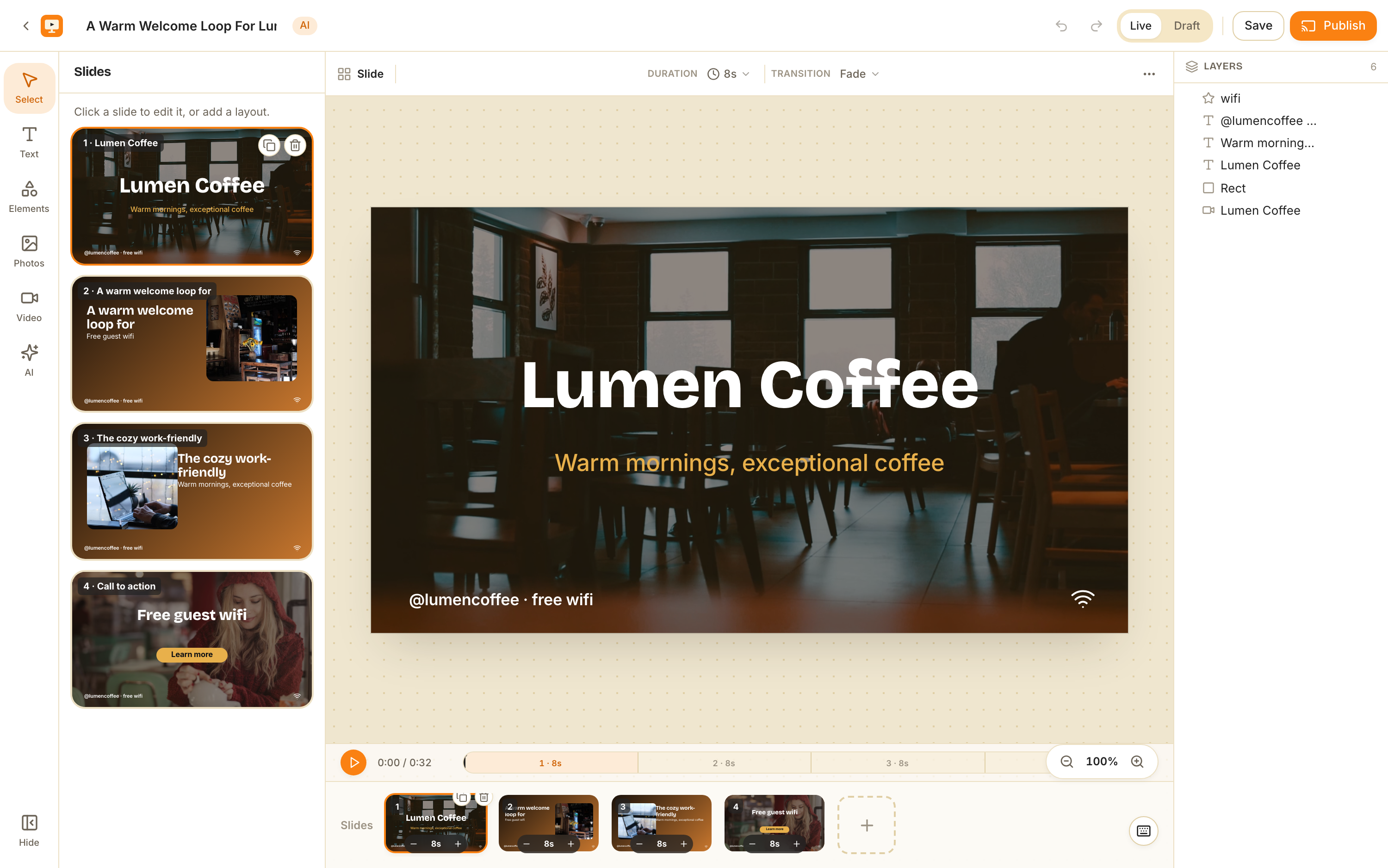
In ChannelOS a menu board is a real, editable show — headings, items, prices and photos are each their own selectable element — that a channel schedule plays on your TVs. Because what’s on the screen is derived from the show plus the schedule plus the clock, you never publish-and-wait: you edit, and the screen already shows it.
Why it matters: a printed board is out of date the moment your prices change. A digital one is only ever as current as your last edit.
Do I need a media player behind each menu TV?
No — you don’t need a media player box behind any menu TV. ChannelOS runs as a web page in the TV’s own browser, so any screen that loads a modern web page can be a menu board: Android TV, Google TV, webOS, Fire TV, or a cheap browser-on-an-HDMI-stick plugged into the display you already have.
To go live you open play.channelos.tv on the TV, scan the on-screen code from your phone, and that screen is running in about two minutes. There’s no player device to provision per screen, and no per-device license to track. The first screen is free; after that it’s per screen per month — no seats, no setup fees. (More on why in no media player required.)
Why it matters: the usual signage bill is mostly hardware and licensing. Strip those out and adding a menu board costs about the price of an HDMI stick.
Can I turn my PDF menu into digital menu boards?
Yes — upload your PDF menu and ChannelOS’s AI reads it and drafts the menu boards for you. It parses the text, headings, sections and prices out of the document and lays them into a complete, on-brand, multi-slide show — appetizers, mains, drinks — instead of you rebuilding the menu by hand.
The output is a real editable show, not a flat export. Every item and price is a selectable element in a Canva-style editor, so you take it the last 10%: swap in a food photo, lift a clean plated-dish cutout with one-tap background removal, or drop in a live clock or a QR widget. Prefer to start from a layout? The templates gallery has menu boards you can remix. This PDF-to-slides flow is the core of AI-first signage; the digital menu board deep-dive covers the board-specific layout choices.
Worked example — the $8 typo. You publish a lunch board across four screens and notice the “Halloumi Wrap” reads $8 when it should be $18. You open the show, fix the one text element, and because the screens derive their content from that show, all four boards correct themselves in seconds — no reprint, no per-screen push, no republish step. Then someone in the kitchen 86’s the soup: you fire a live takeover to pull that item off every screen instantly, and let the normal menu resume once it’s back.
Why it matters: your menu already exists as a PDF. AI-first signage means you don’t retype it — you upload it.
How do I show a breakfast, lunch and dinner menu automatically?
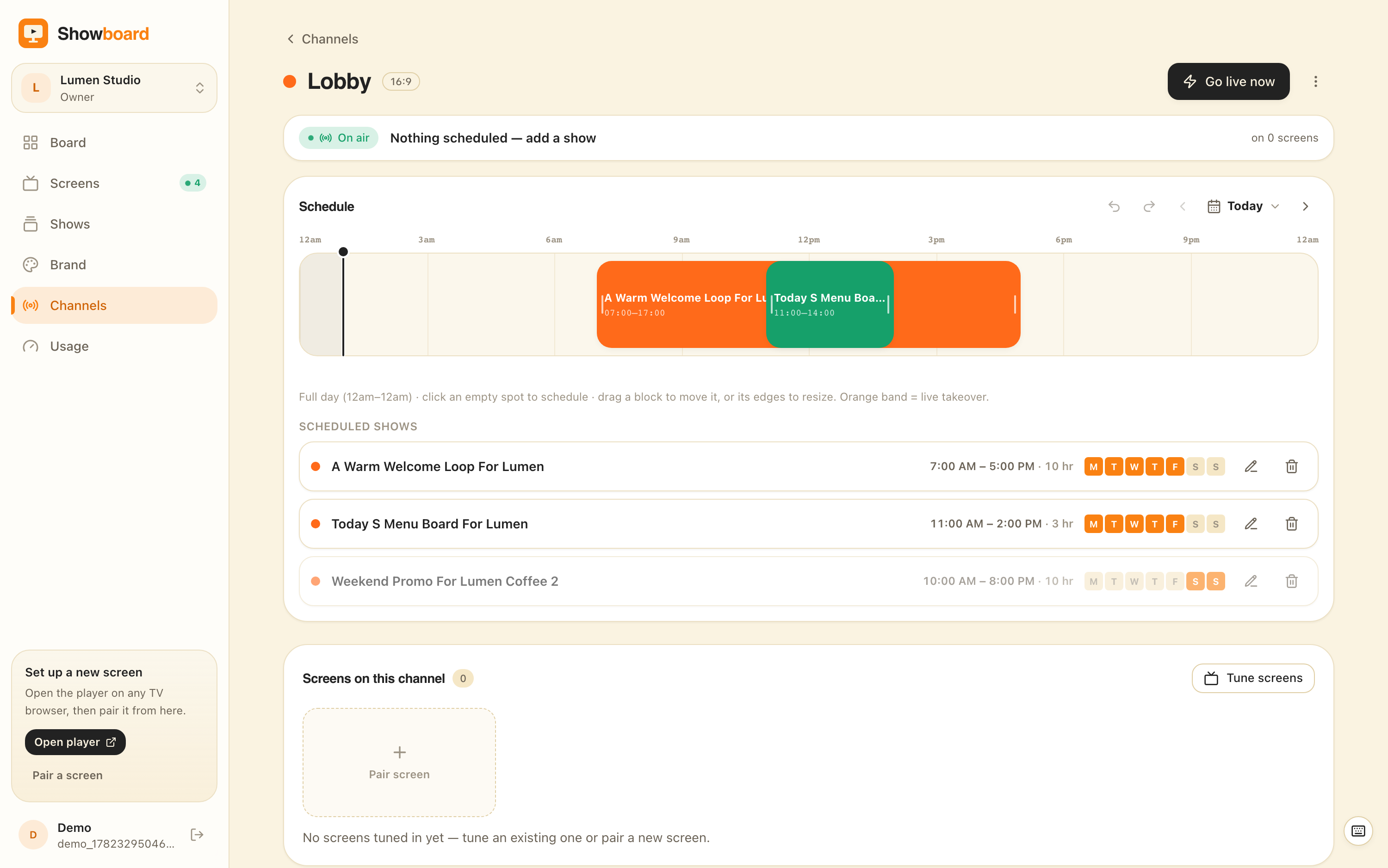
Use dayparting on a channel: you set one schedule and each screen shows the right menu for the current hour on its own clock. A café runs a breakfast board until 11am, switches to lunch specials through the afternoon, and shows the dinner menu at night — set once, runs itself, forever.
The schedule understands weekday versus weekend too, so a weekend brunch board can replace the weekday breakfast board automatically. You build three shows once, drop them on a channel with time windows, and never touch it again — the clock does the switching. Add a QR widget to any board that links to your online-order page, and diners can order from the screen while they wait.
Why it matters: the moment your menu should change is exactly when the floor is busiest. Dayparting means nobody has to remember to swap the board.
Beyond the menu board: the other screens in a restaurant
The board over the pass is the obvious one, but most rooms have a second and third screen job that a printed sign was never any good at.
The waiting area. A screen by the door can run something other than the price list: the day’s specials, opening hours, a QR widget pointing at your online-order or booking page, or a slow Pexels video loop of the kitchen. The QR is a live widget, not a pasted image — change the URL and every screen regenerates the code.
The counter and the collection point. A ticker widget carries a running line (“no bookings after 9pm”, “kitchen closes 10:30”) over whatever else is on screen, and a live clock and weather widget keep a static board from looking frozen. Terrace and beer-garden boards use the weather widget for the same reason.
Allergen, calorie and set-menu detail. These are columns, not headlines, so they belong in a table — a first-class element you draw on the slide, resize by dragging the dividers, and edit cell by cell. A set menu with three courses and two prices reads properly as a table and badly as a text box.
Making the food look like the food. Free Pexels photos and videos are built into the editor, and one-tap background removal lifts a plated dish off its original background so it sits cleanly on your own colour. Group the dish and its caption once and they move together after that.
If you want a running start, the free menu board maker has layouts for 14 cuisines — pizzeria, sushi, burgers, bbq, chinese, thai, italian, mexican, cafe, bakery, bar-pub, indian, food-truck and dessert.
Why it matters: a restaurant rarely needs one screen doing one job. It needs three screens doing three, built out of the same parts.
Running every restaurant screen from one board
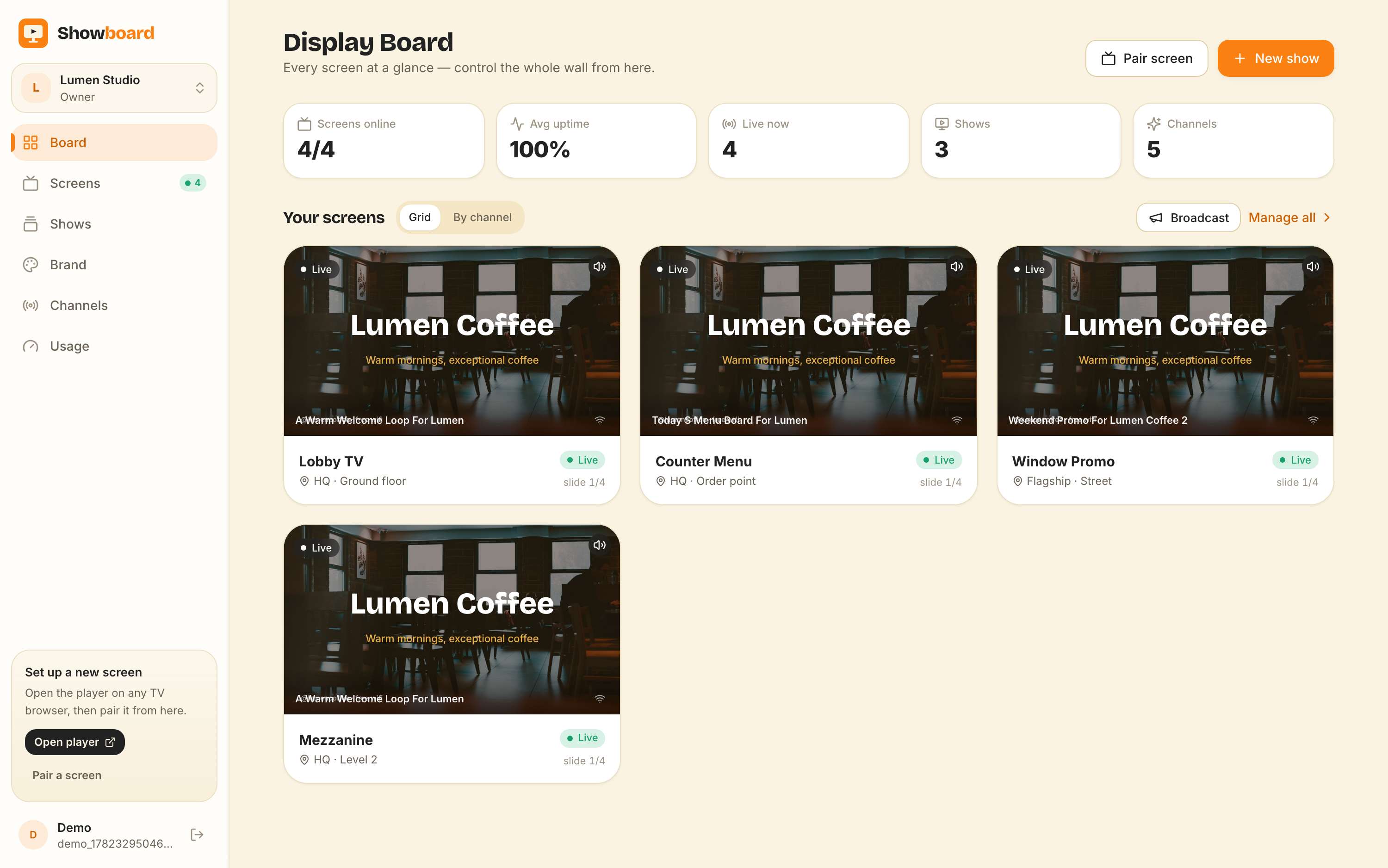
Once there is more than one TV in the room, the question stops being “how do I make a board” and becomes “what is on screen right now, everywhere”. ChannelOS answers that with a live board: every paired screen as a real rendered preview, its status pulsing live, with one-tap controls — play, pause, blank, mute, next, hold — beside it. You look once and you know the wall is alive, including the screen in the function room nobody has walked past since lunch.
Channels are how the screens stay organised. A channel is a named feed with a real daily timeline; screens tune into a channel rather than being fed files one at a time. So the main-room boards and the counter screen can sit on the same channel and change together, while the terrace screen sits on its own with a different evening menu.
Takeover is the manual override for the moments a schedule can’t predict. The soup is 86’d, the card machine is down, a table is being held for a party — you fire a takeover and it cuts in on every screen on that channel immediately, then the normal schedule resumes when you drop it. Nothing gets permanently edited to say a temporary thing.
A second site is a copy, not a rebuild. Channels and shows export as portable files (.show.channelos.tv and .channel.channelos.tv) that import into another workspace, so a second branch starts from the first branch’s finished boards and changes only the prices that differ. A brand kit keeps the fonts and colours identical across both.
Because screens derive what they show from the schedule in real time, there is no publish-and-wait step to get wrong: change the channel and the screens are already following it.
Why it matters: the failure mode of restaurant screens isn’t the design, it’s the one board in the corner still showing last month’s price. A live board makes that visible in a glance.
How much does digital signage for restaurants cost?
Your first screen is free, and after that ChannelOS is priced per screen per month — no per-device player license, no setup fee, no seat charges. Current rates are on the pricing page. Because the TV is the player, the hardware cost is a display you likely already own plus, at most, a cheap HDMI stick.
Here’s the honest comparison against the traditional setup:
| The old way | ChannelOS | |
|---|---|---|
| Player hardware | A media-player box per TV | None — the TV’s browser is the player |
| Menu build | Rebuild each board by hand | AI drafts boards from your PDF menu |
| Fixing a price | Reprint or re-export, re-push | Edit once → live on every screen instantly |
| Breakfast/lunch/dinner swap | Someone swaps it manually | Dayparting swaps it on the clock |
| Licensing | Per-device license per screen | Per screen/month, first screen free |
One honest concession: if you need menu prices to sync automatically from your POS — Toast, Square or Clover — dedicated hospitality platforms still lead there, and ChannelOS doesn’t integrate directly with your POS today. If a live price feed from the register is a hard requirement, weigh that. For the far more common job — getting good-looking, always-current menu boards onto your TVs without a hardware project — ChannelOS is the faster path.
Get your first menu board live
Put your menu on the TVs you already have: pair a screen in about two minutes, upload your PDF and let AI draft the boards, then set breakfast, lunch and dinner to swap themselves with dayparting. Fix a price once and it’s right everywhere; 86 an item and it’s gone in seconds.
No player box, no per-device license — and your first screen is free.
Frequently asked questions
- What is digital signage for restaurants?
- Digital signage for restaurants means running your menus, specials and promos on TV screens instead of printed boards. With ChannelOS the TV itself is the player — it shows a menu board that you edit once and it updates on every screen, so a price change or an 86'd item is corrected everywhere in seconds.
- Do I need special hardware for restaurant menu boards?
- No. ChannelOS runs in the TV's own web browser — Android TV, Google TV, webOS, Fire TV or a browser on an HDMI stick. There's no media player box to buy and no per-device license. You pair a screen by scanning a code from your phone.
- Can AI build my menu board from a PDF?
- Yes. Upload your existing PDF menu and ChannelOS reads its text, headings and prices, then drafts a complete, on-brand, multi-slide menu board. The result is a real editable show — every item, price and photo is selectable — not a flat image.
- How do I show a breakfast, lunch and dinner menu automatically?
- Use dayparting on a channel. You set the schedule once — breakfast board until 11am, lunch specials through the afternoon, dinner menu at night — and each screen tunes into the right menu on its own clock. Weekend hours can differ from weekday hours automatically.
- How much does digital signage for restaurants cost?
- With ChannelOS the first screen is free forever, and additional screens are priced per screen per month — see the pricing page for current rates. There is no media player to buy, no per-device licence and no seat charges, so the hardware side is a TV you likely already own plus, at most, a cheap browser stick. Traditional platforms usually add a player device and a per-device licence on top of the software fee.
- What is the best digital signage for restaurants?
- It depends on what you need to connect. If menu prices must sync live from a POS such as Toast, Square or Clover, a dedicated hospitality platform is still the better fit — ChannelOS does not integrate with a POS today. If the job is getting good-looking, always-current menu boards onto TVs quickly, ChannelOS is faster: no player hardware, AI drafts the boards from your existing PDF menu, and dayparting swaps breakfast, lunch and dinner on the clock.
Your screen is two minutes away.
Open the player on a TV, scan the code, publish a show. Your first screen is free.